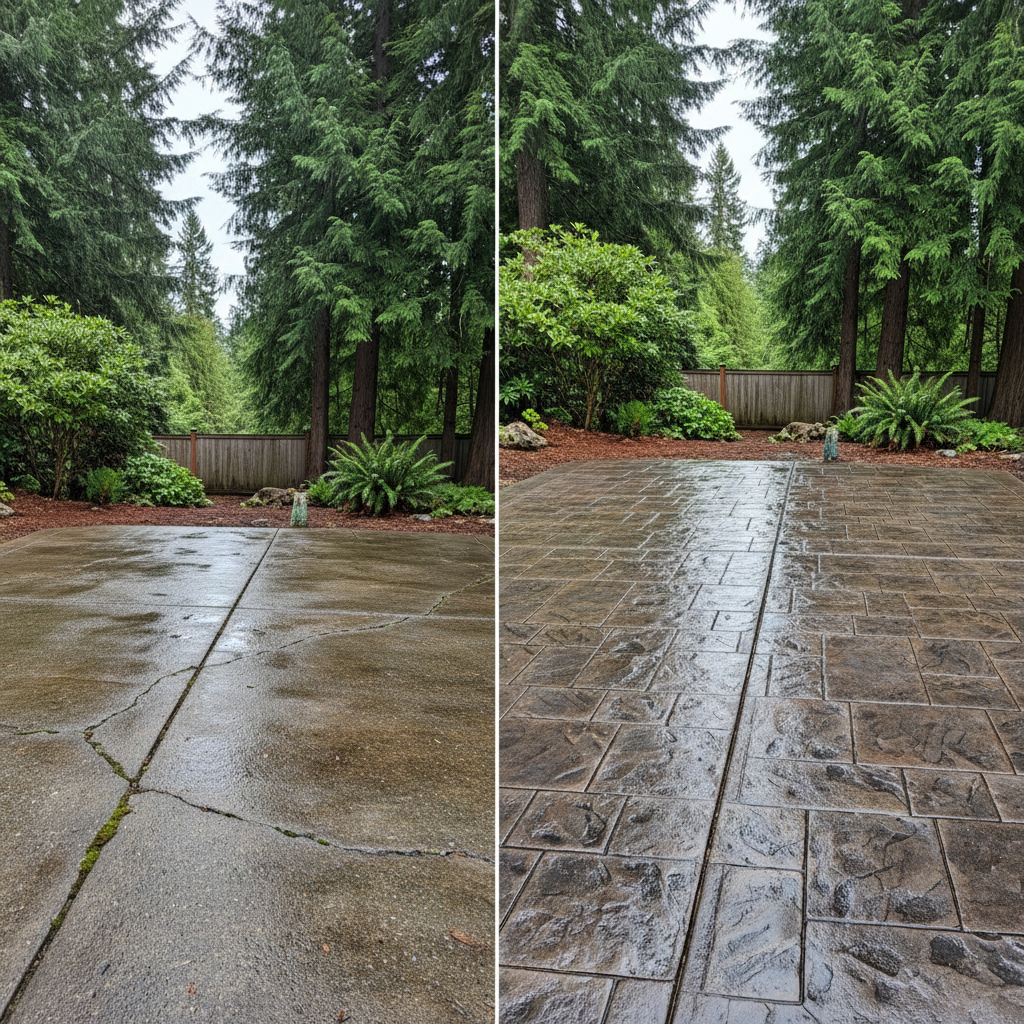
So, you're thinking about stamped concrete. Good call. It's a fantastic way to really boost your property's curb appeal and make it more useful, whether we're talking about a patio, a walkway, or even a driveway. But once you've decided on stamped concrete, you usually hit another crossroads: should you go for a brand-new concrete pour that gets stamped, or put a stamped concrete overlay right on top of an existing slab?
Honestly, it's not always an easy answer. I see folks all over Bothell puzzling over this one constantly. Let's dig into the real differences, what they'll mean for your bank account, and which option will hold up best against our typical Pacific Northwest weather.
Stamped Concrete Overlay: The Resurface Route
An overlay, sometimes called a 'resurface,' is pretty much what it sounds like. We put a new, thin layer of a special concrete mix right over your old concrete slab. This new layer is the part we stamp and color. Think of it as a really tough, decorative skin for that older concrete.
- Cost: Generally, an overlay will cost you less upfront than ripping out and pouring new concrete. You save on demolition, hauling away all that debris, and some of the labor involved in a full-depth pour. If your existing slab is in decent shape – meaning it's structurally sound with no major heaving or cracks wider than, say, a credit card – then an overlay can save you a good chunk of change.
- Durability: This is where you really need to be honest about your existing concrete. An overlay is only as good as the stuff underneath it. If your old concrete is cracking, sinking, or spalling badly, an overlay might just be a temporary fix for a bigger problem. It won't magically fix structural issues. That said, a properly installed, high-quality overlay on a solid base can be super durable. It's usually about 1/4 to 3/8 of an inch thick and built to handle foot traffic and even light vehicle use if it's on a driveway.
- Maintenance: This is pretty similar to new stamped concrete. You'll need to clean it every now and then and reseal it every couple of years, especially with all the rain and moss we get around here. The sealers really protect the color and the surface from wear and tear.
- Appearance: You can get pretty much any stamp pattern and color combo you can dream up with an overlay. The final look can be stunning and, honestly, you often can't tell it from a new pour. The main thing to remember is you're stuck with the existing footprint and height of your old slab. If you wanted to change your patio's shape, an overlay won't do that.
New Stamped Concrete Pour: Starting Fresh
This is the whole shebang: we remove any existing concrete, get the sub-base ready, form up the area, and then pour a brand-new concrete slab that's typically 4-6 inches thick. Then, while it's still wet, we add the color hardeners, release agents, and stamp it with your chosen pattern.
- Cost: More expensive, no two ways about it. Demolition, hauling, more material, more labor. But you're getting a brand-new foundation, right?
- Durability: This is where a new pour really shines. You're starting completely fresh. We can make sure the sub-base is properly compacted, the thickness is right, and we use the perfect concrete mix for our local conditions. For instance, in many Bothell neighborhoods, especially those built on old farmland or near the Sammamish River, we often deal with clay soils that need careful preparation. A new pour lets us tackle these issues head-on, guaranteeing a long-lasting, stable slab. You're getting maximum structural integrity, meaning it's built to last for decades, even with heavy use and our famous freeze-thaw cycles.
- Maintenance: Again, similar to an overlay – regular cleaning and resealing are crucial. But because the slab itself is new and built correctly, you're way less likely to run into underlying problems that could mess with the surface.
- Appearance: The sky's the limit here. You can totally change the shape, size, and even the elevation of your concrete area. Want a bigger patio, or a winding walkway? A new pour lets you design it exactly how you picture it. The patterns and colors are just as versatile as with an overlay.
My Recommendation for Bothell Homeowners
Here's the scoop: if your existing concrete is in really good shape – maybe it's just discolored, a bit worn, or you simply want a new look without any major structural headaches – an overlay can be a fantastic, budget-friendly solution. It's perfect for giving a tired patio or walkway a fresh face.
However, if your existing concrete has serious cracks, uneven sections, drainage problems, or if you want to change the layout or size of the area, then a new pour is almost always the smarter investment. It's more money upfront, sure, but you're getting a structurally sound, long-term solution that you won't have to worry about for a very, very long time. For driveways, especially, I pretty much always suggest a new pour unless the existing slab is practically flawless. Vehicle weight just demands that kind of strong foundation.
Ultimately, it boils down to the condition of your current concrete and what you're hoping to achieve long-term. We've done plenty of both here at Bothell Concrete Solutions, and we're always happy to come take a look at your specific situation and give you an honest assessment. Don't just guess; get an expert opinion on what's truly best for your property.